Development Museum |
Technology |
You may find innovations everywhere in a car, from the engine, its heart, to tires, its hands and feet. The ubiquitous innovations are also applied in the components of the engine, electrical system, production system, chassis, glass, wheels and various accessories. For instance, one of the common electrical parts, the reversing light, was developed in 1921, but it was not until the 60s of the 20th century that the American government required all cars to install this device.The section showcases three topics: “Engine Tour”, “Dancing with the Wind” and “Safety Test Laboratory”. The functional technologies and mystery of automobiles will be demonstrated through the hands-on and interactive approach. |
 |
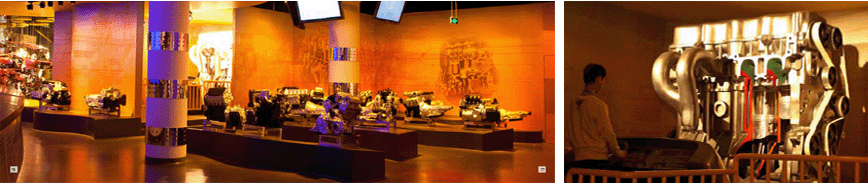 |
| Engine Tour |
An engine is the heart and power of a car.It is due to the great inventions of steam and internal combustion engines that a motorcar, “the vehicle without horses”, was born. Developed from the steam engine, an internal combustion engine burns gas, which led to the development of a gas engine. Later, gasoline and diesel engines came into being on the basis of gas engine. The different engines on display here have one thing in common although they differ in technical features and functional performances. Like a man who must inhales oxygen and exhales carbon dioxide, all engines also “inhale” air, burn fuel and then turn fuel into power. In the process a car can “fly like an arrow”. |
 |
Dancing with the Wind |
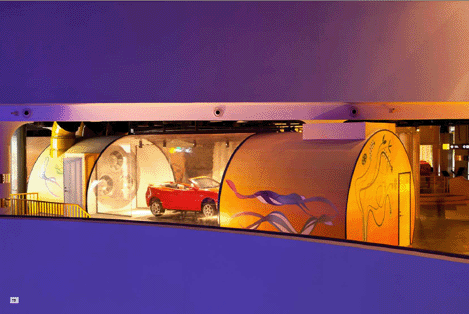
Wind constitutes the greatest resistance for a speeding car. The faster a car goes, the greater the resistance. In a sense, the evolution of a car amounts to its battle against the wind. This battle also gave birth to aerodynamics as well as the wind tunnel in the lab.Aerodynamics studies the interaction between air or other gas and a flying object or other entities in motion, as well as the subsequent physical and chemical changes. Wind tunnel is a tunnel in which artificial air current or wind is generated. Experiment of automotive wind tunnel is also conducted in this tunnel. Automotive companies, in their research and development, make clay models, which are used in the experiment of wind tunnel. They then work at every part of a car with great care based on the results of the experiment, so as to let the drag coefficient up to the standard. |
|
| In 1982, the performance of aerodynamics of automobiles became an important norm of car designing.Here is a simulation wind tunnel specially designed for you. Why not experience the great power of the fierce gale and dance with the automotive wind! | |
| Safety Test Laboratory | 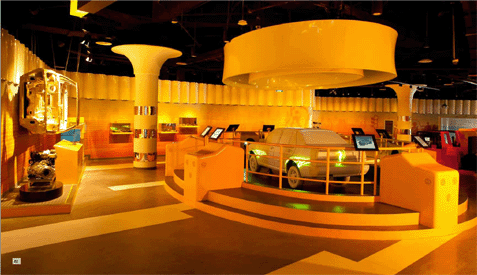 |
The issue of safety has been man’s concern ever since the automobile was made. It has become more obvious and the key research topic as the speed of cars has increased dramatically and car has become a household commodity. In the course of one hundred years in developing motorcars, man has racked his brains to improve and perfect the safety performance as the problem is closely linked with the happiness and woe of the drivers. For example, the “three-point seat belt” developed in 1959 saved hundreds of lives as it can secure the bodies of both the drivers and passengers safely in the car. The belt also prevented millions of people from being hurt in accidents. The Patent Office of Germany listed it as one of 8 patented designs that can most effectively save people’s lives during the 100th anniversary of the birth of automobile from 1885 to 1985. |
|
| Safety is the most crucial factor in assessing a car’s performance. In the safety test lab, you can get to know the many measures and technologies meant to protect the safety of the drivers. You can also go into the simulation car to explore and experience the various safe ways of driving in diverse climates and traffic conditions. | |
