Development Museum |
Manufacture |
|
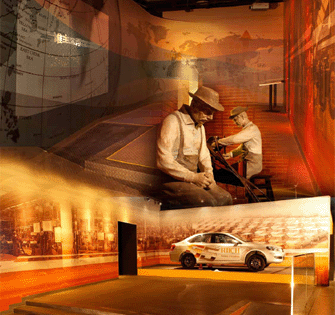
Automotive industry is able to develop by leaps and bounds on account of the replacement of manual process by modern mode of production. At the turn of the 20th century, cars were produced in small numbers in Europe, usually ordered by nobility. Europeans considered manual process a necessary craftsmanship in the automobile industry. In the US, however, the manual process was superseded gradually by assembly lines in the war time. And Henry Ford was the leading figure in this respect. While Germany produced 20000 units in 1914, Ford rolled out as many as 310000 units of T Model cars in the same year.Modern mode of production such as assembly lines and constantly striving for perfection not only enabled Ford, GM, Toyota and other companies to become the automotive tycoons, but also introduced new management concept and management skills worldwide, greatly pushing the development of automotive industry to a new level.This section features three themes: “Modern Times”, “Production Line” and “Who Wins”. They will illustrate how the transformation from manual process to modern mode of production in automobile industry was realized through vivid simulation setting and life-like experience. |
 |
 |
Modern Times |
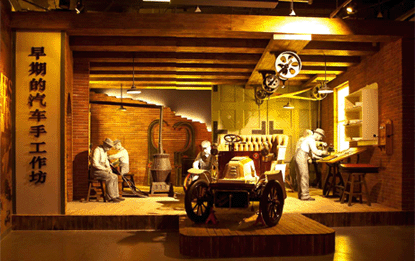
The earliest cars were produced in very simple and crude workshops, where workers used backwards tools to forge and hammer. In 1896, Henry Ford, the would-be giant in automotive industry, was 30 years old, who also set up a carmaking lab at the backyard of his house. In 1931, his company developed the first assembly line in the world in Detroit. Thereafter, American and European automotive manufactures quickly followed suit in installing their own assembly lines, so car-making by hands was Scrapped. However, even now, the tradition of manual craftsmanship is still used in producing luxury sedans. |
| Who Wins |  |
Although car originated from Europe, it was the assembly line developed inthe US that made the car a popular commodity and realized the first automotive revolution in the world. However, Europe, relying on its constant technological innovations, dramatically increased its automotive output and became again the automotive center in the world in the 60-70s of the 20th century. This marked the second revolution in automotive industry. But in Europe and America it suffered a great depression owing to the oil crisis in the 70s, while Japan, due to its cars of low-fuel consumption, surpassed America in terms of car output in 1980, thus becoming the number one car manufacturer of the world. And this change heralded the third revolution in the automotive sector. |
|
The fast-changing situation characterizes the 120 years of car-making history. In 2009, China’s car units exceeded 10 millions, ranking it as the biggest car market in the world. What is the prospect of automotive industry in the future? Who will be the winner in the competition in the automotive market? Here is the good place for you to ponder these questions. |
|
 |
Production Line |
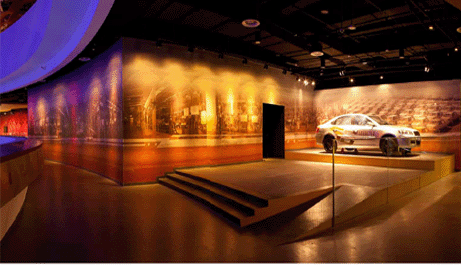
Henry Ford once said proudly that the assembly line makes it possible to have the spare parts walk towards you, instead of you coming over to them. A car can be assembled so long as a worker sits by the conveyer belt and does the same and simple action repeatedly. As a result, all the redundant and ineffective labor was discarded. In the meantime, production increased exponentially. Furthermore, operation of this kind does not call for complicated skills and strength. Even a handicapped person can secure the job. In 1915, the automotive output of Ford Corporation alone accounts for 70% of all cars produced in the United States.How can a production line puts together all the parts and transforms them into a complete car? Why not ride on our “car” to see for yourself how spare parts are processed on an assembly line? |
